| St. Francis of Assisi-Meadowvale Stewardship This is an exciting time for St. Francis. Advisory Board has approved the next step in the process that is moving us into a three-year plan for the work of the church. Fanning the Flames Workshop, in May 2005, identified seven areas that we should focus on to develop this plan. Project-based committees have been struck to look into what St. Francis is dong presently, to identify what further needs there are in the community, and to identify how St. Francis can support those needs. The committees are as follows:
These committees will be reporting their progress regularly to the Advisory Board and are expected to have clear recommendations in place for review by Vestry in February 2006. If you would like participate on one of these committees, contact the leaders or leave a message, indicating your name and your area of interest, at the church office: 905-814-0905. Fanning the Flames Community demographics (click on link to go to details) Worship (click on link to go to details) Outreach (click on link to go to details) Christian Education (click on link to go to details) Pastoral care (click on link to go to details) Evangelism (click on link to go to details) A summary of our 2004 survey *(click on link to view details of this)
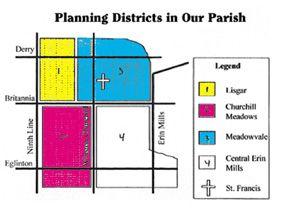
Statistics about Meadowvale The information was analyzed for major trends in five areas: General Population, Family Structure & Children, School Attendance & Education, Mobility, and Labor Force. General population. While the median age remains in the low 30s, the appearance of a young parish is misleading, as the overall trend is towards an aging of the population.. Between 2000 and 2006, we can expect a five percent increase in the Over 35 age group, with a corresponding downward trend among the Under 35s. (That trend is likely to continue. By 2021, Mississauga expects about 14 per cent of its population to be age 75 and over. Right now, it’s about 5 per cent. The 0 to 9 age groups will have dropped to 11 per cent from 17 per cent.) Coupled with this is the trend towards a smaller family, with two older children who are likely in full-time higher education, or unemployed. Growth in Churchill Meadows and Lisgar are projected by the City of Mississauga to be minimal through 2006. The maximum density of new homes in Churchill Meadows is not expected until 2021. New population growth within the parish through 2006 will be mainly in rentals. Family structure and children. Those families with one child are trending up in relationship to total common-law relationships. The lone parent family is trending up marginally, with a slight emphasis on the lone female parent of three or more children. There is also growth in families with single fathers so this may be an area of interest for outreach programs. 3. School attendance and education. A large trend is evident in 15 to 24 year olds who are attending educational institutions full time, with a very large trend towards community college education. A very large trend up in university education is detected, with a similar trend up in receiving university degrees. The trend of decreasing numbers of small children may have implications for our Sunday school and should be investigated further. A few bits about Mississauga Languages First Language - From Statistics Canada 1996 Census Data (as a percent of total)
Business opportunities An employment survey conducted in 1994 indicated that the greatest number of firms and of employees were active in the manufacturing/warehouse sectors followed by retail and wholesale sectors. There will be a shift in the employment base away from traditional manufacturing and towards: light assembly, warehouse distribution, and general services. The strong industries in Mississauga are: pharmaceuticals, electronics, computer, chemical and transportation parts and equipment industries. Mississauga demographics indicate that the labour market is experiencing some fairly dramatic changes. It is predicted that in the next ten years, 70% of the new Canadian work force will consist of women, racial minorities, and people with disabilities. It is also evident that the Mississauga labour force is aging as fewer young people are available to take entry level jobs and many present employees are struggling to adapt to the changing economic climate. Diocese of Toronto The Diocese includes the fastest-growing suburban region in Canada and also covers a large rural area. Nearly five million people live within the diocesan boundaries, 376,000 of whom identify themselves as Anglicans. There are about 80,000 people on the dioceses’ parish rolls. The Diocese is home to many culturally diverse and language-based congregations, including Chinese, Filipino, French, Hispanic, Japanese, Korean, and Tamil. There are many congregations with parishioners from Africa, the Caribbean, Europe, India, Middle East, Pakistan, Sri Lanka, and many other parts of the world. Recent additions to the Diocese include a Sudanese fellowship group and a Franco-African congregation. We worship both as individuals and as a community. Our Sunday worship is the one most commonly thought of when we hear the word. For members of St. Francis, the main service is a high service, full of “smells and bells”, that help people focus on their spiritual connections. But there are many ways to worship: worship beads, meditation and personal prayer are ways for individuals to worship; daily offices, evensong, and special services like World Day of Prayer are more common methods of corporate worship and prayer at our church. Definitions Absolution - A declaration by a bishop or priest, announcing forgiveness by God to those who have confessed their sins and repented. Acolyte - From a Greek word meaning, "to follow." Acolytes are lay volunteers who follow the Cross in the procession and recession and assist the priest in worship. An acolyte lights and sometimes carries candles, and helps in the preparation of communion. Agnus Dei - From two Latin words: angus, meaning "lamb" and dei, meaning "of God." The term refers to a three-part litany frequently said or sung after the fraction in the Holy Communion part of the Eucharist. Altar Guild - A special lay service group in a church who prepare the altar and maintain the furnishings in a church building. The altar guild usually supervises all seasonal church decorations and is usually responsible for all flower arrangements. Church of England - The official name of the original Church in England, the Anglican Church. During the reign of King Henry VIII, the Church, in England, broke formal ties with Rome and became the Church OF England. Sometimes referred to as the "C of E." Ciborium - A cup that resembles a chalice, except that it has a removable lid. A ciborium is used to hold communion wafers during the Eucharist Colors - Color plays an import part in the designation of seasons and feasts in the Episcopal Church. Each church season has a color associated with it. Advent is purple (the color of preparation and penitence) or Marian Blue (in honor of Mary), Christmas is white (the color celebration), Epiphany is green (the color of growth; growth of the gospel message from Jew to Gentile - re: the three Wise Men), Lent is purple, Easter is white, and the season after Pentecost is green (for the growth of the church). Weddings and funerals are usually occasions for white (the color of celebration) while Pentecost Sunday and ordinations are red, to signify the presence of the Holy Spirit. Black is occasionally used one day a year -- Good Friday. Sacristy - A room near the altar where the communion vessels, altar hangings, candlesticks, etc. are kept and cleaned. The room is often seen as the exclusive domain of the Altar Guild. Parson - From the Latin word persona, meaning "person." From the eleventh century English, where there term was a legal one, applying to the parish priest, because in all matters he was the designated "person" to deal with. Today, the term is not used as often as it was, and often evokes rural connotations. Priest - A special term for an ordained minister of a Roman Catholic or Anglican or Orthodox church; In Roman circles, the term refers to those who recite the mass, but the Anglican church traces the word's origin to a Celtic corruption of the official term for clergy - presbyters. The duty of a priest, according to the prayer book, is to baptize, preach the Word of God, and to celebrate the Eucharist, and to pronounce absolution and blessing in God's name. Seasons - A way of marking time in the Church. There are six seasons: Advent, Christmas, Epiphany, Lent, Easter, and the season after Pentecost. The church new year begins with the season of Advent, which marks the coming of our Lord. Advent begins four Sundays before Christmas day. Christmas is a 12-day season that begins Christmas day and continues to Jan. 6. Epiphany is both a day (Jan.6) and a season, and represents the manifestation (epiphany) of the gospel into the world. Lent begins 46 days before Easter with Ash Wednesday, and is a time of preparation for Holy Week and Easter. Easter is a seven-week (50 day) season which ends on Pentecost Sunday. The season after Pentecost runs from Pentecost to Advent. "Smells & Bells" - A lighthearted way of describing a "high" church, referring to the parish or mission's frequent use of incense (Smells) and Sanctus bells (Bells). Tabernacle - A small cabinet (sometimes a vessel) designed to contain the Reserved Sacrament. The tabernacle may be built into the altar, sit on the altar, on the retable, or it may be built into another part of the sanctuary. In very Low Churches the tabernacle will not be found anywhere. Whitsunday - The old name for Pentecost Sunday, the day described in Acts 2. As of the 1979 Book of Common Prayer, the day became known as Pentecost. The term "Whitsun" is a corruption of the German "Pfingsten," which means "pentecost" or "fiftieth," which is how many days Pentecost occurs after Easter. (source: The Prayer Book Reason Why - Nelson Boss, Morehouse-Gorham, 1942) Quiz Answers 2. Which of the following are Outreach programs are supported directly by St. Francis or its committees? 3. The number of people waiting for affordable housing in Peel is: 4. The Dam is located: 5. How much did St. Francis parishioners give to Faithworks in 2004? 6. In 2004, how much did our Diocese spend on outreach programs? Diocesan general support Diocese adult programs The Lay Academy is five days of adult Christian education designed to enhance one’s Christian ministry, formal or informal. The program is founded on the understanding that our Christian life and ministry rests on three legs: one’s personal spiritual life, an intellectual understanding of the Christian faith, and ministry skills. Diocese youth offerings God, Kids & Us is a vital guide book for all who care about the full inclusion of children and their families in the life of the church today. An engaging blend of theory, story, and practical resources for congregations committed to welcoming and nurturing children and those who care for them. Help! I’m a Sunday School Teacher is a workshop, offered by the Church Army, that covers three key areas: knowing yourself, knowing your job, and knowing your class. It helps answer the questions: why do we need Sunday school today; what is it we hope to achieve; how can I be the best I can be for the children? Deanery offerings St. Francis youth and children programs Vacation Bible School provides a week-long opportunity for Christian education for the younger members of the parish, church campus, and community in a fun and friendly environment. Vacation Bible School is an extension of Church School. Baptism Preparation provides Christian education for parents to help them prepare for the commitment they are making on behalf of their child. St. Francis adult offerings Weekly, the minister also offers a sermon on Christianity and its role and relevance in today’s world. Ministers and others are invited to give sermons or homilies at Sunday services. Special services are also offered; Instructed Eucharists, Stations of the Cross, and Black Sunday celebrations are all part of the education programs.
Simply defined, evangelism is the planting or growth of the church. Based on the last year’s survey results, virtually everyone wants the church to grow. This can mean many things: bringing back lapsed members, welcoming visitors and new members, going out into the community to bring those in who might be interested in becoming members of St. Francis. How do we fit into the Anglican world? Here is how the diocese defines the parish on its website under Sustainable and Strategic Ministry: “Although our parishes have a fairly autonomous form of governance and management, the parish always exists in the context of the mission of the Diocese. It delivers ministry to the local community on behalf of the whole Diocese. In that respect, our parishes and our Diocese always exist and work together in mutuality of interest.... “The Diocese of Toronto has experienced a profound increase in population and shift in demographics like no other area in Canada. This has resulted in dramatic changes in the size and make-up of local communities. We have seen shifts in location, ethnicity and religious affiliations of people, changing needs and changing expectations of people in many communities. “This, in turn, has affected how we carry out the mission of our Diocese through the local congregation. We have many examples of a congregation or parish established years ago, that no longer fits the local community’s needs. The symptoms:...shrinking Sunday attendance, shrinking financial resources, deterioration of buildings and church fabric as the local congregation is unable or unwilling to maintain the ‘beauty of holiness’. “On the other hand, we also have emerging and growing communities where we have no local or adequate expression of our mission and ministry. The demand for space in the pews or in the church school outstrips the resources which we allocated to that community years ago.” Diocese infrastructure support Church building grants - Capital project grant funding may be provided for the expansion of existing churches, building of a new church, or property improvements to enhance Ministry. The Ferguson Grant is for the construction, buying, alteration or renovation of a building or buildings within the Diocese of Toronto for use as a home for aged men or women.
|